$26.5M
Capped raise across five tranches (50.5M AUR, avg. $0.525) — sized so the base-case pool is 2.0x the raise
AURUM (AUR) is a gold-production participation token: 50% of Memnon Capital Africa's revenue share from the Kasanda Gold Project funds a monthly buyback-and-burn and a physical-gold reserve for five years. Engineered for 2.0x base-case coverage — every token unsold at closing is burned.
Private placement to eligible professional investors only. Subject to Mauritius FSC approval — expressions of interest are non-binding and no funds are accepted at this stage. Not offered to retail investors in Uganda or any jurisdiction where unlawful.
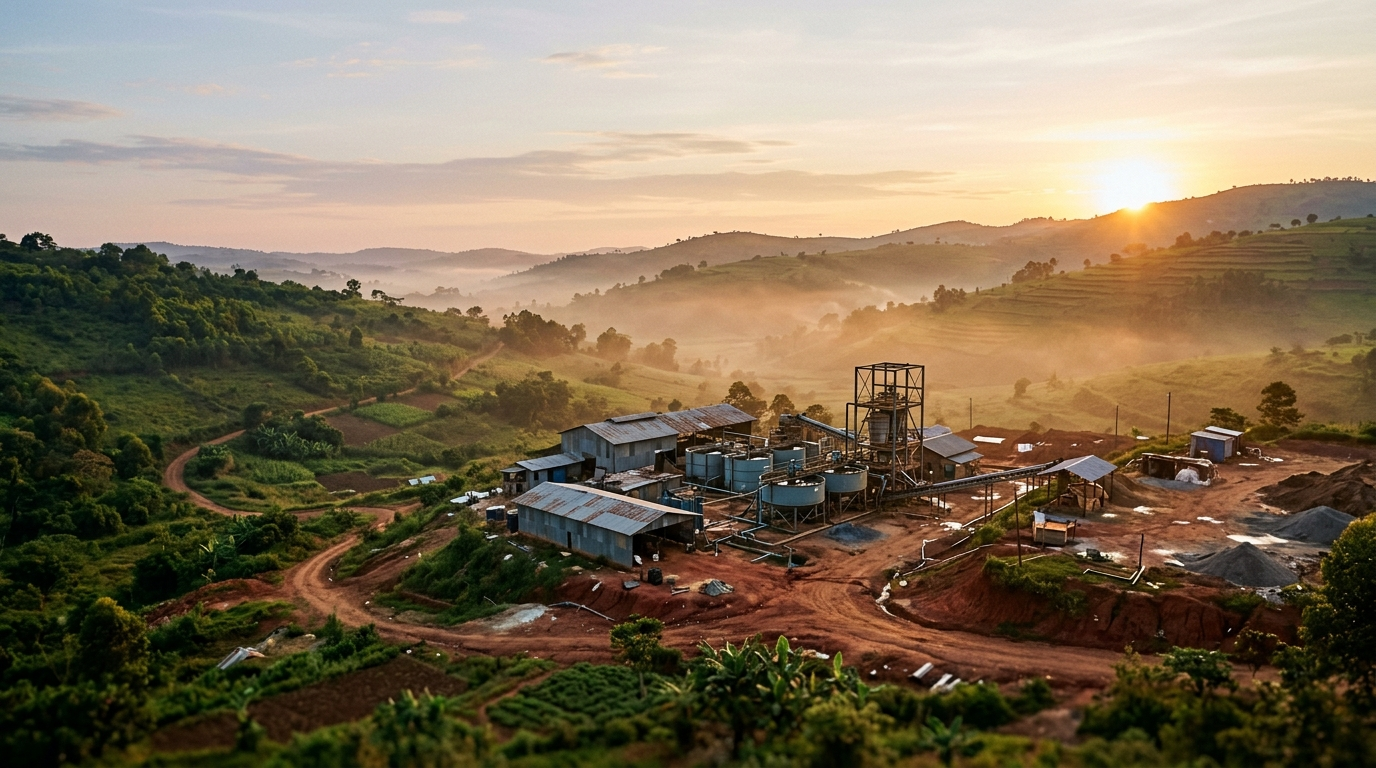
Who Memnon is — the king of the dawn, the company in Kampala, and the Kasanda Gold Project.
How the buyback-and-burn works, the tokenomics telemetry, the Return Map, and the road to exchanges.
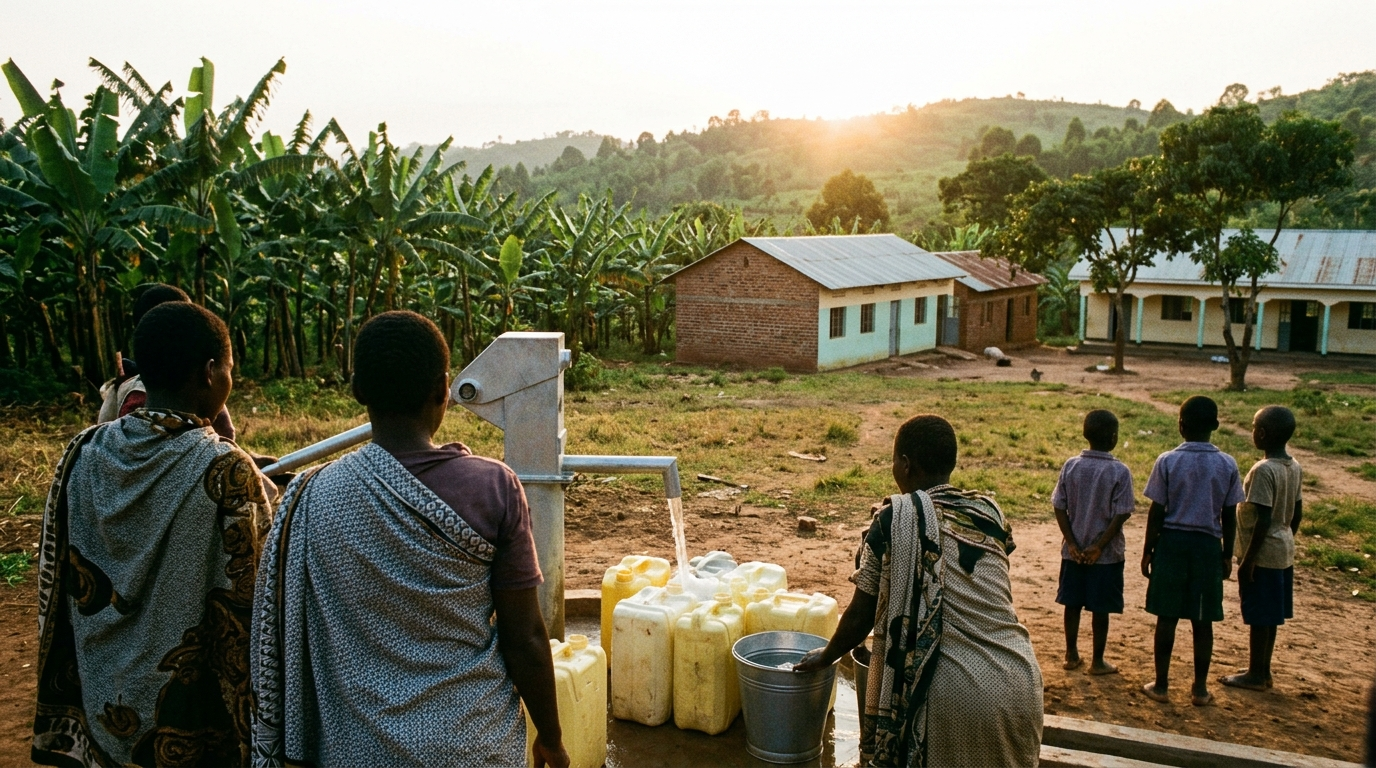
Formalising artisanal mining, local jobs, schools and water — gold that builds the place it comes from.
100,000,000 AUR are minted at genesis — no more will ever exist. 50,500,000 are offered to investors across five priced tranches for a capped raise of $26.5M; 11,500,000 are locked for treasury, market-making and team under on-chain vesting; and the remaining 38,000,000, plus anything unsold, are burned at closing — the Founding Burn. Supply only falls, from the very first day.
Each AUR is a digital security issued by a Mauritius special-purpose vehicle holding a contractual participation deed over 50% of Memnon Capital Africa's revenue entitlement from the Kasanda Gold Project (SML 00575, Uganda) for five years from first distribution, secured by assignment against offtake proceeds. Receipts land in escrow monthly; 75% is deployed by a rules-based smart contract to buy AUR on the market and burn it permanently, and 25% is converted monthly into allocated physical gold held for the programme — so the redemption floor is denominated in grams of gold, not just dollars. Direct gold ownership underneath, a shrinking supply above. Holders gain two ways: the recurring revenue-funded bid under the price, and a compounding share of every future cycle as supply shrinks. A five-year sunset distributes the remaining reserve pro-rata — no stranded holders.
Early tranche logic. The buyback executor purchases at market price. Capital that enters at $0.30 owns claims identical to capital entering at $1.00 — the tranche ladder is the reward for underwriting the programme earliest, the pre-launch tranche is capped at 10,000,000 AUR, and the whole raise is capped at $26.5M for one reason: the base-case pool must be twice the money in.
"Everything that pays you is signed, scheduled, and on-chain — check it yourself."The AURUM principle · Kasanda Gold Project · Uganda
We publish the maths investors should demand. Planning parameters: 360 t/day CIL throughput, 6.0 g/t head grade (planning case), and Memnon's 25% share of project revenue. Every figure below moves with recovery, utilisation and the gold price — so we show the range, not just the headline — and the raise is capped at the number that makes the base case pay 2x.
| Scenario | Recovery · Days | Gold produced | Gross revenue @ $4,200/oz | Memnon 25% share | Token programme (50%) |
|---|---|---|---|---|---|
| Conservative | 82% · 310 | 549 kg · 17,657 oz | $74.2M | $18.5M | $9.3M / yr |
| Planning case | 88% · 330 | 627 kg · 20,167 oz | $84.7M | $21.2M | $10.6M / yr |
| Upside | 92% · 350 | 696 kg · 22,363 oz | $93.9M | $23.5M | $11.7M / yr |
| Full theoretical | 100% · 350 | 756 kg · 24,306 oz | $102.1M | $25.5M | $12.8M / yr |
| Operations ↓ · Gold → | $3,600/oz | $4,200/oz (spot ref.) | $4,800/oz | $5,400/oz |
|---|---|---|---|---|
| Conservative (82% · 310d) | $39.8M · 1.50x | $46.4M · 1.75x | $53.0M · 2.00x | $59.6M · 2.25x |
| Base / planning (88% · 330d) | $45.4M · 1.71x | $53.0M · 2.00x | $60.6M · 2.29x | $68.2M · 2.57x |
| Upside (92% · 350d) | $50.1M · 1.89x | $58.5M · 2.21x | $66.9M · 2.52x | $75.2M · 2.84x |
Plant optimisation and the planned gold refinery and minting facility — the infrastructure that later enables physical redemption of AUR in minted gold.
Deployment capital for the broader multi-plant rollout across licensed Ugandan gold projects — growth funded without diluting a single share of equity.
Regulatory, audit and platform costs of the token programme itself, and seeding of the redemption reserve that backs the floor from day one.
Expressions of interest are open to eligible investors from USD 5,000. When the pre-launch allocation is gone, the price steps to $0.40.
Subscribe — Expression of Interest
Memnon is a name with three thousand years behind it — and a company in Kampala carrying it forward.
In the oldest Greek epics, Memnon was king of Aethiopia — an African king — and the son of Eos, goddess of the Dawn, and the mortal Tithonus. When Troy called for help, Memnon marched his armies north and stood against the greatest of the Greeks.
He fell to Achilles himself — no lesser opponent could touch him — and the epics say his mother the Dawn wept for him each morning, her tears the dew on the grass. Zeus, moved, granted him immortality: the only warrior at Troy so honoured. Centuries later, when the Greeks reached Egypt and found two colossal seated statues on the Nile that hummed at first light, they knew immediately whose they must be. They called them the Colossi of Memnon — the son singing to his mother, the Dawn, every sunrise. Emperors travelled to hear it.
That is the name over our door: an African king remembered for three millennia, honoured by his greatest rival's world, greeting each dawn. Where legacy meets ambition is not a slogan we wrote; it is the story we inherited.
Aurum, Latin for gold, descends from the ancient word for the glow of sunrise — the same root as aurora. Memnon is the Dawn's son; aurum is the Dawn's gold. When we named the token, the mythology had already done the work: AURUM is the gold of the Dawn's son — an African king's gold, struck at first light.
Memnon Capital Africa Ltd. is a Uganda-anchored investment platform headquartered in Bugolobi, Kampala, building across three verticals: mining, energy, and infrastructure.
The firm was founded on a simple conviction: Africa's resources create lasting value when they are developed formally — licensed, audited, taxed, and partnered with the communities and governments that host them. Memnon's leadership joins deep Ugandan roots and standing with international capital-markets and operating experience; its portfolio spans a producing gold licence, exploration ground, energy participations and agriculture. Everything the group builds follows the same doctrine: own the licence, build the infrastructure, keep the chain of custody, publish the numbers.
Every operation sits on a granted licence with government and community agreements in place — the boring foundation everything else stands on.
Our Ore-to-Doré operating system records every tonne and every gram in an append-only ledger from pit to pour — the evidentiary spine of the AURUM attestations.
Plant, refinery, mint: value is kept where it is created. The planned Kasanda refinery and minting facility brings the full chain — and physical AUR redemption — in-house.
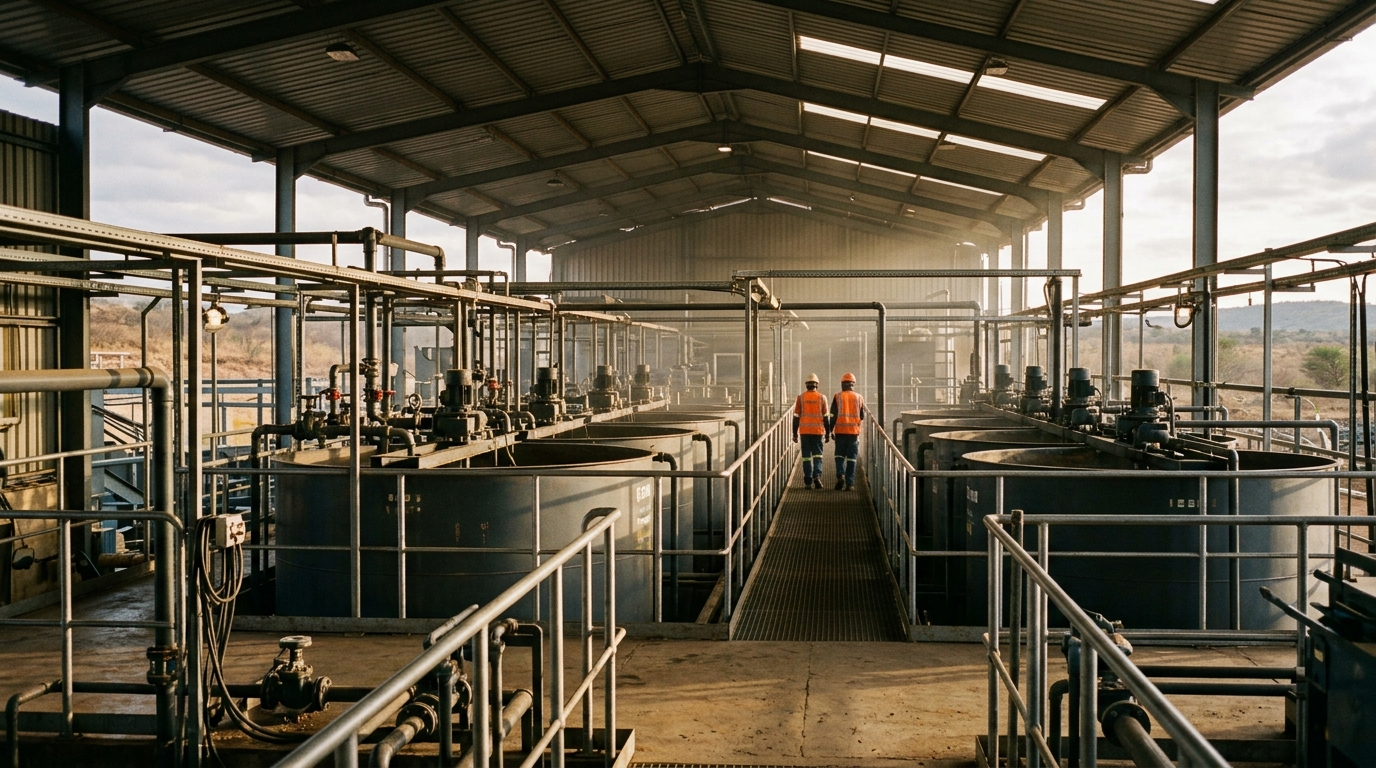
"Own the licence. Build the infrastructure. Keep the chain of custody. Publish the numbers."The Memnon doctrine
The Kasanda Gold Project operates under Small-Scale Mining Licence SML 00575 in central Uganda's gold belt — a producing asset, not a promise on a map.
Ore moves from pit to plant to pour under the Ore-to-Doré system: every batch weighed, assayed and signed into an append-only record, reconciled monthly by an independent auditor against offtake settlements. Downstream, the group's planned refinery and minting facility closes the loop — refining Kasanda doré on site and striking the minted AURUM rounds that token holders will one day redeem. The mine funds the token; the mint makes it touchable.
The token turns Kasanda's monthly gold revenue into a shrinking supply and a gold-backed floor.
Explore the Token See the Impact
One hundred million minted. Thirty-eight million burned at closing. Every month after that, the mine buys and burns more.
Aurum is Latin for gold — the reason gold's chemical symbol is Au. Its ancient root means "the glow of dawn": the same root that gives us aurora. To the Romans, gold was literally sunrise made metal.
And Memnon? In Greek myth, Memnon was the son of Eos, goddess of the Dawn — an African king who marched his armies north to stand at Troy, so favoured that Zeus granted him immortality when he fell. The Greeks named the great colossi on the Nile after him, because at first light the stones were said to sing — the son greeting his mother, the Dawn.
So the name was never invented; it was found. Memnon is the Dawn's son. Aurum is the Dawn's gold. AURUM is the gold of an African king, struck at first light — mined in Uganda, minted under the Corinthian helmet, and burned coin by coin as the ledger rises each month like the sun. The ticker AUR carries all of it in three letters that every chemist, banker and jeweller on earth already knows.
AURUM — Latin: gold; root: "dawn-glow" (kin to aurora)
MEMNON — Greek myth: African king, son of Eos, the Dawn
AUR — the ticker; Au, gold's chemical symbol, plus R for royalty
And on the reverse, the mint mark ᚠ — Fehu, the first rune of the Norse futhark, whose meaning is wealth itself. Greek myth on the obverse, Norse wealth-rune on the reverse: two ancient worlds, one coin.
Every burn permanently retires supply, so each surviving token's claim on all remaining distributions grows — automatically, monthly, without the holder doing anything. Sellers are paid by the revenue-funded bid itself; holders compound. And beneath the market sits the reserve-funded redemption floor: a published NAV price at which any holder can exit in quarterly windows, converting "trust me" into "test me."
Everything that pays you is signed, scheduled, and on-chain — check it yourself.
AUR is a security token — it lists on regulated digital-securities venues, not retail crypto exchanges. That is a feature: every counterparty is verified, and every listing is legally durable. The pathway is staged.
Target venues in the MERJ Exchange (Seychelles) and Fusang (Labuan) class — licensed securities exchanges that list tokenized instruments from emerging-market issuers, with achievable listing requirements and same-region credibility. Objective: a lawful public price and secondary exit for early subscribers as fast as the track record allows.
Applications to venues in the class of Archax (UK FCA-regulated), SDX (Switzerland's SIX Digital Exchange), INX (US-registered digital securities), and US alternative trading systems such as tZERO or Oasis Pro — bringing institutional order flow, custody integrations and Gulf/European investors. ADGM-standard documentation is drafted from day one to make these applications re-papering, not re-engineering.
Binance- and Coinbase-tier venues cannot list a permissioned security today — but the largest exchanges are building regulated securities arms, and tokenized RWAs are converging with mainstream markets. When a top-five venue opens a compliant security-token board, AURUM's audited track record is the application. We will be ready; we will not jump early.
| Stage | Venue class | Requirements | Typical cost | Timeline |
|---|---|---|---|---|
| 1 — ASAP | MERJ / Fusang class | 6 attested cycles, audited SPV accounts, contract audits, legal opinion | $50–120K | 2–4 months post-qualification |
| 2 — Institutional | Archax / SDX / INX / US ATS class | Stage-1 record + enhanced disclosure, custody and MM mandates | $120–300K | 6–12 months per venue |
| 3 — Majors | Top-tier exchanges' regulated securities boards | Multi-year audited record; venue regulatory readiness | TBD | Opportunistic |
Named venues illustrate the class and are targets, not commitments; final selection follows venue rules, counsel advice and Board approval. What we will never do: unregulated offshore listings or open DEX pools — the ERC-3643 whitelist blocks them by design.
Engineered for 2.0x base-case coverage. The earliest capital gets the widest margin.
Subscribe — Expression of Interest
Formal mining is one of the most powerful development engines rural Africa has — when it is done in the open, on the books, and in partnership.
Across Uganda's gold belt, most gold has historically moved through informal channels: unlicensed pits, unsafe conditions, untraceable sales, nothing returned to the community or the country. Memnon's model is the opposite by design — and the AURUM token strengthens it.
A licensed mine with an audited chain of custody pays wages formally, buys locally, pays royalties and taxes that fund Ugandan public services, and answers to regulators and neighbours alike. Every kilogram that flows through Ore-to-Doré instead of the informal market is a kilogram that develops the district it came from. Formalisation is not a side programme at Memnon; it is the business model.
Working with Uganda's artisanal and small-scale mining associations to bring informal miners into licensed, organised operations — safety equipment and training, fair and documented pay, and a legal market for their output instead of the shadow one.
Hiring from the villages around Kasanda first and buying local where local can supply — food, transport, construction, services — so the payroll and the supply chain develop the district, not just the pit.
Community investment around operations: school support, clean water points, and health outreach in partnership with local leadership — chosen with the community, not for it.
Progressive rehabilitation of worked ground, responsible tailings management, and a restoration mindset carried over from the group's nature-restoration ventures in East Africa.
"Every kilogram that moves through the formal chain develops the district it came from."Kasanda district · central Uganda
Community commitments connected to the AURUM programme will be formalised in the offering memorandum; this page describes the group's development approach and standing practice around its operations.
The pre-launch tranche funds the next stage of formal, audited gold production — 10,000,000 AUR at $0.30.
Subscribe — Expression of Interest10,000,000 AUR in the pre-launch tranche — from USD 5,000, by expression of interest. When it's gone, the price steps to $0.40.
Submit your expression of interest below — your payment instructions appear immediately with your personal reference, and the subscription agreement and KYC pack follow by email from info@memnonca.com. Payment is by USD bank wire only. Your allocation attaches once cleared funds are received and definitive documents are executed, subject to Mauritius FSC approval.
Tokenized gold is among the largest real-world-asset categories on public blockchains: spot trading volume in tokenized gold reached approximately USD 90.7 billion in the first quarter of 2026 alone, and the two category leaders — Paxos Gold (PAXG) and Tether Gold (XAUT) — together hold more than USD 4 billion in market capitalisation, with institutional venues onboarding gold tokens and BlackRock- and JPMorgan-scale institutions active across the wider USD 31 billion-plus tokenized RWA market. Yet every material product in the category is custodial: a digital receipt for bullion already vaulted in London or Zurich. Holders receive price exposure and pay storage; none participates in the margin between production cost and spot — the economics that have made listed gold-royalty companies premium performers for decades. AURUM tokenizes that production participation at source, from a licensed, operating African gold project, inside a compliance architecture built to the standard of the category's regulated leaders. AURUM takes its name from the Latin for gold — whose ancient root means "the glow of dawn" — chosen because Memnon, in Greek myth, was the African king who was son of Eos, the Dawn: the Dawn's gold, for the Dawn's son.
The underlying asset is the Kasanda Gold Project, held under Small-Scale Mining Licence 00575 in the Republic of Uganda and operated within a joint-venture structure in which Memnon Capital Africa Ltd. holds a 25% revenue entitlement. The project operates a carbon-in-leach (CIL) processing plant with a design throughput of 360 tonnes of ore per day, with a planning-case head grade of 6.0 g/t Au. Production is recorded end-to-end in an append-only digital chain-of-custody system from ore intake through doré pour to offtake settlement, providing the evidentiary base for the monthly attestations on which the token mechanism depends. A gold refinery and minting facility is planned downstream, which — once commissioned — enables physical redemption of AUR in minted gold.
| Tranche | Tokens | Price | Proceeds | Status |
|---|---|---|---|---|
| T0 — Pre-Launch (limited) | 10,000,000 | $0.30 | $3,000,000 | Expressions of interest open |
| T1 | 12,500,000 | $0.40 | $5,000,000 | Upcoming |
| T2 | 15,000,000 | $0.50 | $7,500,000 | Upcoming |
| T3 | 8,000,000 | $0.75 | $6,000,000 | Upcoming |
| T4 | 5,000,000 | $1.00 | $5,000,000 | Upcoming |
| Investor total (avg. $0.525) | 50,500,000 | — | $26,500,000 | Capped raise |
Minimum subscription USD 5,000; maximum USD 1,000,000 per subscriber in T0. Payment by bank wire to the issuer's account, with instructions issued only upon acceptance and countersignature of the subscription agreement. Tranches may close early or be re-sized downward by the Board; unsold tranche tokens are burned, never re-priced. Of the 100,000,000 genesis tokens, 38,000,000 are designated for the Founding Burn — destroyed on-chain at closing together with any unsold tranche balance — leaving a post-closing float of approximately 62,000,000. The remaining allocations are 6,000,000 to treasury and listing liquidity (24-month timelock), 3,000,000 to market-making mandates, and 2,500,000 to team and advisors (36-month vest, 12-month cliff). The raise is capped at USD 26.5 million deliberately: it is the figure at which the base-case five-year distribution pool equals exactly twice the capital subscribed (Section 10).
The issuer SPV holds a participation deed entitling it to 50% of Memnon Capital Africa's revenue entitlement from Kasanda — economically, 12.5% of gross project gold revenue (50% × Memnon's 25%) — for a period of five years commencing on the first monthly distribution, governed by English law, secured by assignment of offtake proceeds, and paid into the issuer's escrow account within ten business days of each offtake settlement. The deed contains no operational obligations on token holders and no recourse to them; it is a one-way revenue conduit. A Board-held extension option (Section 10) permits lengthening the participation window in holders' favour; the window can never be shortened.
All investor-facing numbers derive from four parameters: throughput (360 t/day), head grade (6.0 g/t planning case), metallurgical recovery, and operating days. Contained gold at full parameters is 2.16 kg/day. The model below is stated at USD 4,200/oz:
| Scenario | Recovery | Days | Gold /yr | Gross revenue | Memnon 25% | Programme 50% |
|---|---|---|---|---|---|---|
| Conservative | 82% | 310 | 549 kg | $74.2M | $18.5M | $9.3M |
| Planning | 88% | 330 | 627 kg | $84.7M | $21.2M | $10.6M |
| Upside | 92% | 350 | 696 kg | $93.9M | $23.5M | $11.7M |
| Theoretical max | 100% | 350 | 756 kg | $102.1M | $25.5M | $12.8M |
Grade sensitivity is material and disclosed: at 4.0 g/t (all else planning case) annual programme receipts fall to approximately USD 7.1M; at 8.0 g/t they rise to approximately USD 14.2M. Gold-price sensitivity at planning-case operations: USD 9.1M/yr at $3,600/oz; USD 10.6M/yr at $4,200/oz; USD 12.1M/yr at $4,800/oz. Distributions are a function of actual attested production and realised prices; nothing in this paper is a forecast or promise.
Let R(t) denote attested programme receipts for month t, S(t) circulating supply, P̄(t) the volume-weighted execution price of the buyback window, V(t) the redemption reserve, and F(t) the published floor:
Execution is a five-trading-day time-weighted-average-price schedule encoded in the executor contract, triggered only by the joint signature of the attestation oracle and the escrow confirmation. No party — issuer, sponsor, or operator — holds discretionary timing authority; a missed attestation automatically pauses the cycle and notifies all holders. Burned tokens settle to the null address; the burn hash publishes with the attestation pack. Because S(t) only falls while receipts persist, each surviving token's fractional claim on all future cycles rises monotonically: abstaining holders compound without action, and sellers are paid by the revenue-funded bid itself.
The 25% reserve tranche is converted monthly into allocated physical gold, vaulted for the programme (initially with an accredited custodian, subsequently at the group\u2019s own refinery vault upon commissioning), so the floor is denominated in grams of gold and published in both grams and USD — holders own gold underneath the token, not a promise of dollars. Accrual beyond an eighteen-month floor-liability target converts to supplementary burns. Holders may redeem at F(t) in quarterly windows with T+10 settlement. Upon commissioning of the planned refinery and mint, a physical redemption option is activated at a defined gram-weight of minted gold per token, subject to minimum quantities and assay terms in the offering memorandum. At the end of the participation window, a sunset distribution pays the entire remaining reserve, plus any terminal receipts, pro-rata to all outstanding tokens — the programme cannot strand its last holders.
AUR is implemented on Ethereum mainnet under the ERC-3643 permissioned-token standard: transfers execute only between wallets on the issuer's KYC whitelist, enforcing investor-eligibility rules at the protocol layer. No mint function exists after deployment; supply can only decrease. Treasury, market-making and team allocations are held in on-chain timelock and vesting contracts visible to all holders, and sponsor-affiliated wallets are contractually and technically barred from selling during buyback windows. The circulating-supply figure published in the holder portal is computed from chain state, not from issuer statements.
| Application | Indicative share | Purpose |
|---|---|---|
| Kasanda expansion & refinery/mint | ~40% | Plant optimisation; construction of the gold refinery and minting facility enabling physical redemption |
| Platform growth | ~35% | Deployment capital for additional licensed Ugandan gold projects under the group's multi-plant rollout |
| Working capital | ~15% | Group operations supporting the producing asset base |
| Programme costs & reserve seed | ~10% | Regulatory, audit, platform, listing costs; initial seeding of the redemption reserve |
The strategic logic: this is growth capital raised against a defined revenue slice — no equity dilution, no fixed debt service, no covenants, and a cost of capital estimated at 10–16% depending on realised production, against the 22–30% returns frontier-mining equity investors demand.
The raise is not sized by appetite; it is sized by arithmetic. The five-year base-case distribution pool is approximately USD 53.0M (Section 5). Capping the raise at USD 26.5M sets base-case coverage at exactly 2.0x — a 100% programme-level return. The full map across operating scenarios and gold prices:
| Operations ↓ · Gold → | $3,600 | $4,200 (ref.) | $4,800 | $5,400 |
|---|---|---|---|---|
| Conservative (82% · 310d) | 1.50x | 1.75x | 2.00x | 2.25x |
| Base (88% · 330d) | 1.71x | 2.00x | 2.29x | 2.57x |
| Upside (92% · 350d) | 1.89x | 2.21x | 2.52x | 2.84x |
The upside band therefore runs 150–184% returns at stronger operations and $4,800–5,400 gold; the conservative floor of the map is 1.50x at planning assumptions. Three levers push beyond the map: the Board\u2019s holder-favourable option to extend the participation window; contribution of additional project revenues by deed amendment (each added project raises receipts against an already-shrinking supply); and gold itself. Three cautions keep it honest: multiples are programme-level (pool ÷ raise) delivered through buybacks, the gold reserve and the sunset — individual outcomes depend on entry tranche, market price paths and holding behaviour; grade is the single largest sensitivity (Section 5); and the map is a model on stated assumptions, not a promise. Early tranches carry the widest margin of safety — a $0.30 entry subscribes at 57% of the blended average.
The base case is not the test of an instrument; the bad year is. Four downside scenarios, run against the capped raise of USD 26.5M, with the structural response to each:
| Stress | Assumption | Programme receipts /yr | 5-yr pool | Coverage | Structural response |
|---|---|---|---|---|---|
| ST-1 Gold shock | Gold $2,800/oz, planning ops | $7.1M | $35.3M | 1.33x | Buybacks shrink but never stop; floor accrual slows; extension option becomes the natural remedy |
| ST-2 Grade disappointment | 3.5 g/t, 85% rec., 320 days, $4,200 | $5.8M | $29.0M | 1.09x | Full disclosure in monthly attestations; low entry tranches retain partial protection; sunset still distributes reserve |
| ST-3 Production halt | Six-month stoppage in year 2, planning otherwise | $10.6M (halted months: $0) | $47.7M | 1.80x | No attestation → cycle auto-pauses, publicly; reserve keeps the floor bid alive through the outage; window may be extended by the halted period |
| ST-4 Combined downside | $3,200/oz + conservative ops (82%/310d) | $7.1M | $35.4M | 1.34x | Worst modelled case still funds ~$26.5M of buybacks and ~$8.8M of gold reserve over five years — 1.34x the capped raise; the deed has no leverage above it to accelerate against holders |
What no stress scenario can do: mint new tokens (no mint function exists), divert receipts (escrow with assignment security), skip a burn quietly (a missed attestation is publicly visible and auto-pauses the cycle), or strand terminal holders (the sunset clause). What every stress scenario does do: reduce distributions — yet note what the capped raise buys: every stress scenario, including the combined downside, remains above 1.0x coverage. The 2.0x base case is the target; breakeven-or-better is the stress floor. Later tranches still carry less margin of safety than earlier ones.
Every material figure in this paper, classified by its basis. "Market data" is verifiable from public sources as of July 2026; "planning assumption" is a project parameter subject to performance; "computation" follows arithmetically from stated inputs.
| Figure | Value | Basis |
|---|---|---|
| Tokenized gold Q1 2026 volume | ~$90.7B | Market data |
| PAXG + XAUT market cap | >$4B combined | Market data |
| Gold spot reference | $4,200/oz (sensitivities $2,800–4,800 shown) | Market data; fluctuates daily |
| Throughput | 360 t/day | Planning assumption (plant design) |
| Head grade | 6.0 g/t (3.5–8.0 sensitivities shown) | Planning assumption; single largest sensitivity |
| Contained gold | 2.16 kg/day = 360 × 6.0 g | Computation |
| Planning-case output | 627 kg/yr = 2.16 × 88% × 330 | Computation on assumptions |
| Gross revenue, planning | $84.7M = 20,167 oz × $4,200 | Computation |
| Memnon entitlement | 25% of project revenue | Contractual (JV structure) |
| Programme share | 50% of Memnon = 12.5% of gross | Deed term (this offering) |
| Programme receipts, planning | $10.6M/yr; 5-yr pool ~$53.0M | Computation |
| Capped raise | $26.5M = Σ five tranches (avg $0.525) | Computation (offering terms) |
| Base-case coverage | 2.0x (stress floor 1.09x; upside to 2.84x) | Computation; see Sections 10–11 |
| Uganda restriction | BoU directive bars licensed institutions from crypto dealing; 2023 High Court ruling; FIA AML registration regime | Regulatory record |
| Mauritius regime | VAITOS Act 2021, FSC-licensed token offerings | Regulatory record |
Anything not in this register should be treated as descriptive. Where market data and this paper diverge after publication, live sources prevail; where planning assumptions and reality diverge, the monthly attestations are the record.
The issuer is a Mauritius special-purpose vehicle (in formation) to be licensed under the Virtual Asset and Initial Token Offering Services Act 2021, regulated by the Financial Services Commission, with resident directors, a compliance officer and a money-laundering reporting officer. AUR is a security and is treated as one: the offering is made exclusively to eligible professional investors under private-placement exemptions (Regulation S-equivalent outside the United States), through an offering memorandum which alone governs. Offering documentation is drafted to ADGM FSRA digital-securities standard to keep Gulf and institutional venue applications a matter of re-papering. Uganda-side obligations are confined to the participation deed, applicable taxation, and Financial Intelligence Authority AML registration; the offering is not made in or into Uganda, where dealing in virtual assets by licensed institutions is restricted by Bank of Uganda directive and no domestic licensing pathway currently exists. United States persons are excluded from the initial offering.
Stage 1 (as soon as qualified — approximately six attested cycles): listing on a regulated securities exchange in the MERJ (Seychelles) / Fusang (Labuan) class, providing a lawful public price and secondary exit. Stage 2 (12–24 months): applications to tier-one digital-securities venues in the Archax (UK), SDX (Switzerland), INX and US alternative-trading-system class, with custody integrations and market-maker mandates funded from the 4% MM allocation. Stage 3: the regulated securities boards of top-tier global exchanges as they open to permissioned security tokens — pursued on track record, never prematurely. The issuer will not list on unregulated venues and the token cannot enter open DEX pools; the whitelist enforces both.
Holders receive information rights, not operational control. The participation percentage, the 75/25 split, and the executor rules are fixed in the deed and contracts, amendable only in holders' favour or by a 75% token-holder vote with regulator notification. Monthly: attestation, escrow statement, burn proof, supply and floor publication. Quarterly: management report and holder AMA. Annually: audited SPV financial statements reconciling every cycle. A public transparency dashboard exposes supply, cumulative burns, the latest attestation and the floor to anyone, whether or not they hold AUR.
"Attestation" means the monthly auditor certificate reconciling production and offtake settlements; "Programme receipts" means amounts actually received by the issuer under the participation deed; "Floor" means the reserve-derived redemption price published per Section 6; "Professional investor" bears the meaning given in the offering memorandum by reference to applicable law in each subscriber's jurisdiction. In any conflict between this paper and the offering memorandum, the memorandum prevails absolutely.